

Overview
The Google Drive connection allows Qontext to ingest documents, presentations, tables, and text files from a connected Google Drive into your context repository.Only files and folders that the connected Google account can access will be ingested into your context repository.
Unsupported:
Recommended setup
Use a dedicated integration user in your Google Workspace to ensure a stable and uninterrupted connection.
The integration user will:
- Authenticate the connection between Qontext and Google Drive.
- Access required resources with read and download permissions.
Setting up the connection
You can connect Google Drive from your Qontext workspace, authorize access in Google, then choose what to sync and how often. The steps below walk you through the full flow.You can also manage all your credentials, including Google Drive, from the Sources page.
1
Open Sources in your workspace
In the Qontext app, open your workspace and go to the Sources tab, then click + Connect data source.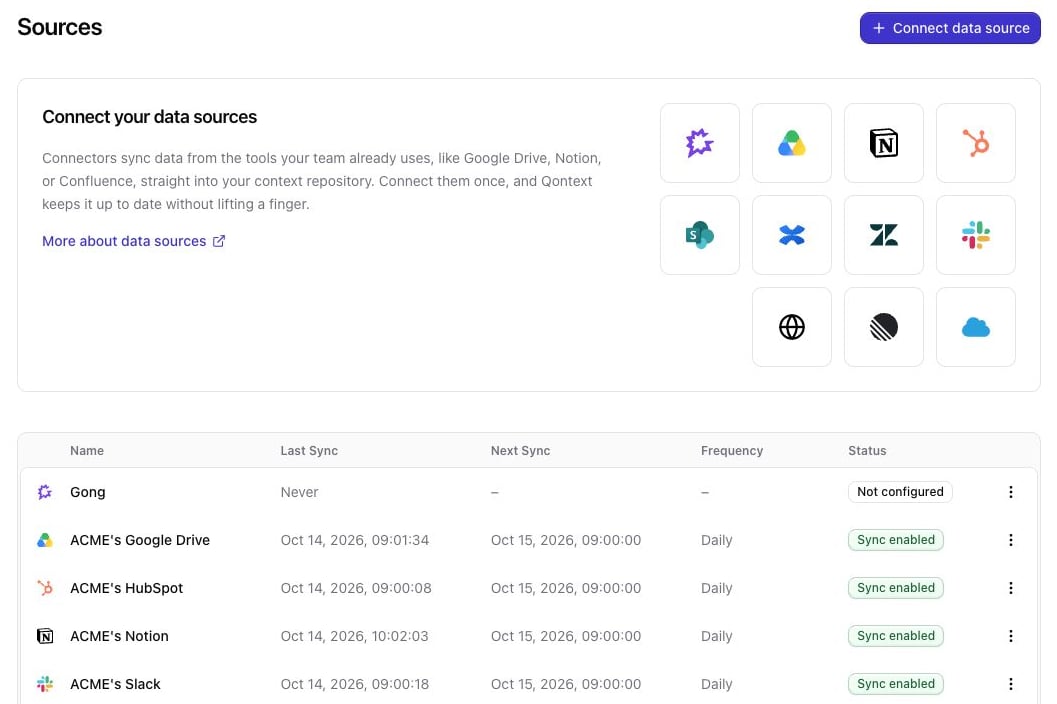
2
Select Google Drive as the data source
Choose Google Drive from the list of available data sources. This starts the Google Drive connection flow.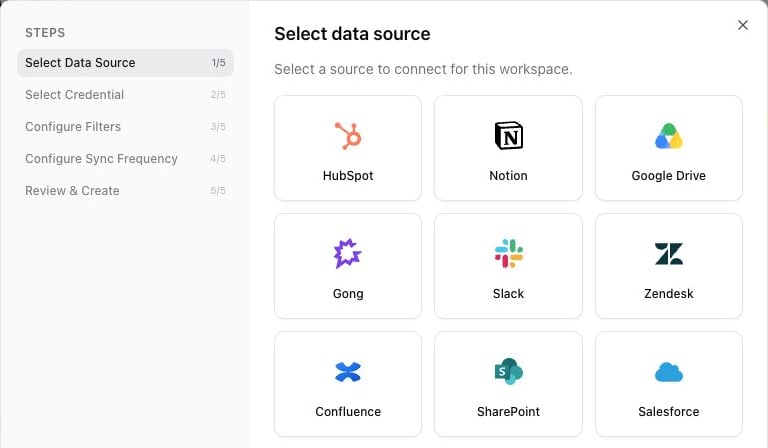
3
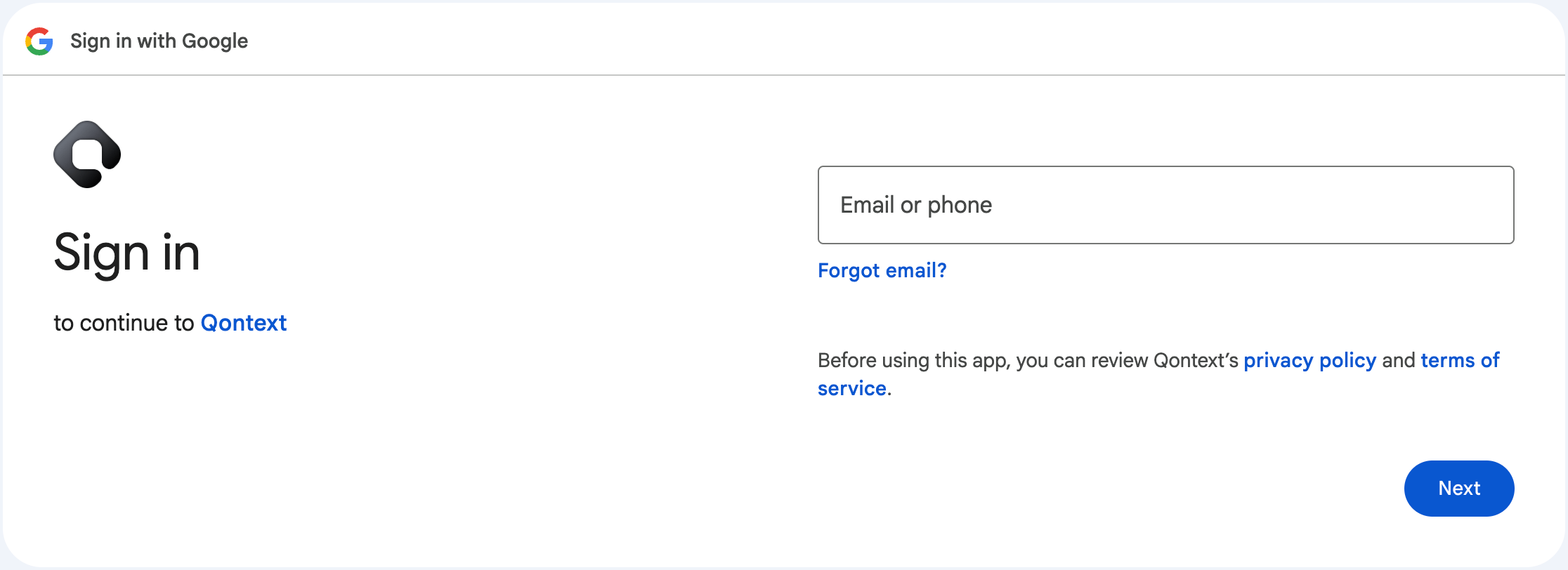
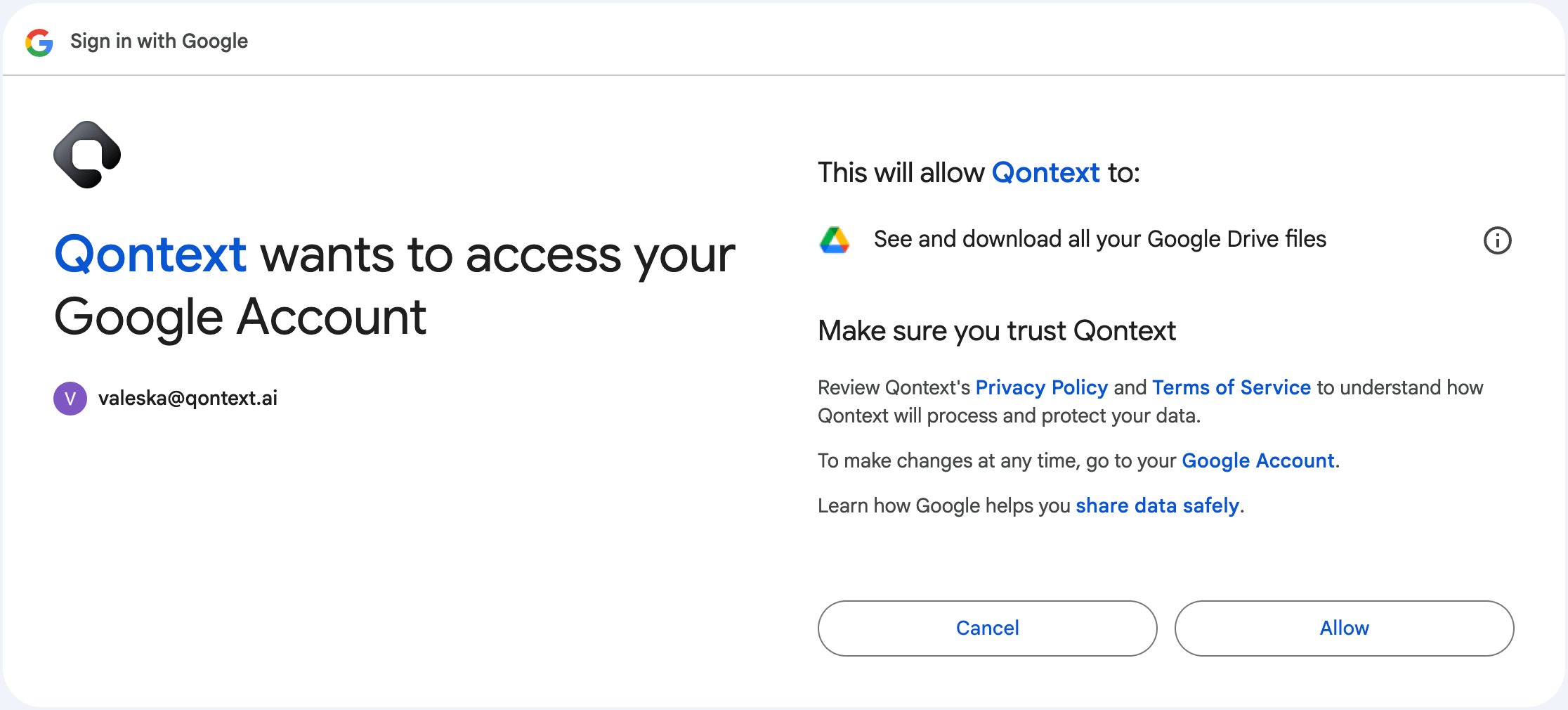
Choose Google account and grant scopes
You can reuse existing Google Drive credentials (if you’ve already connected this account to Qontext) or create a new connection.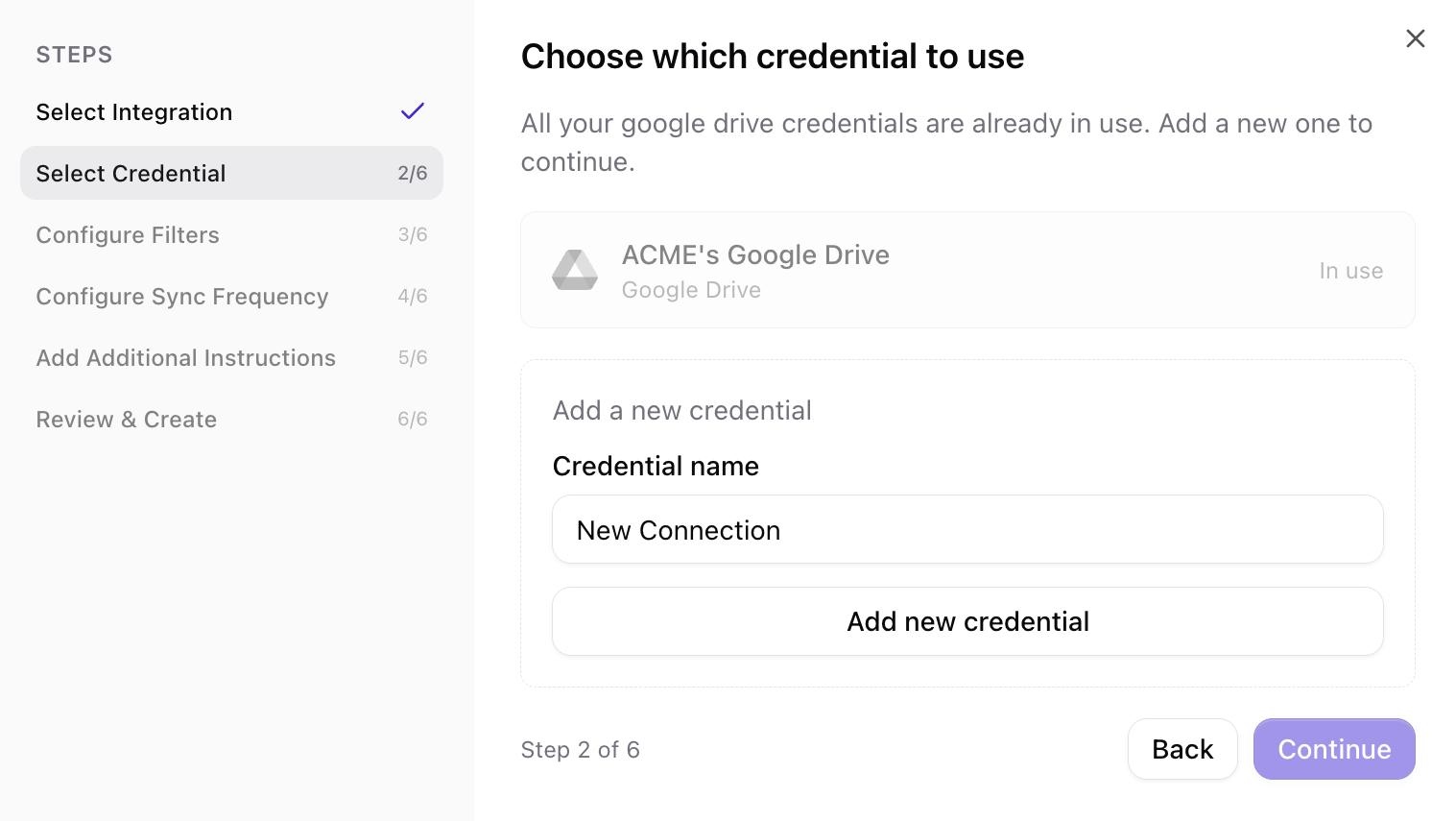
4
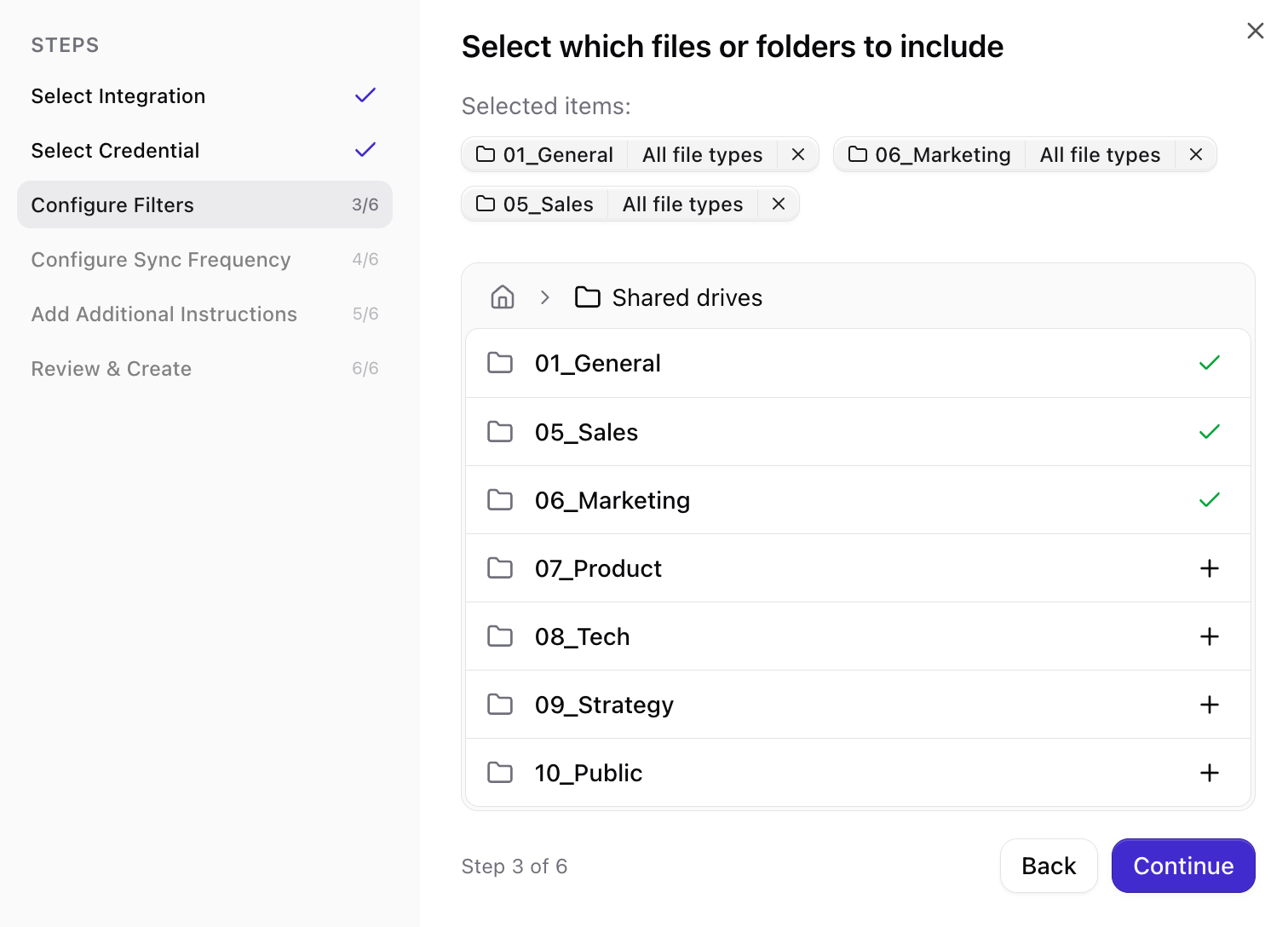
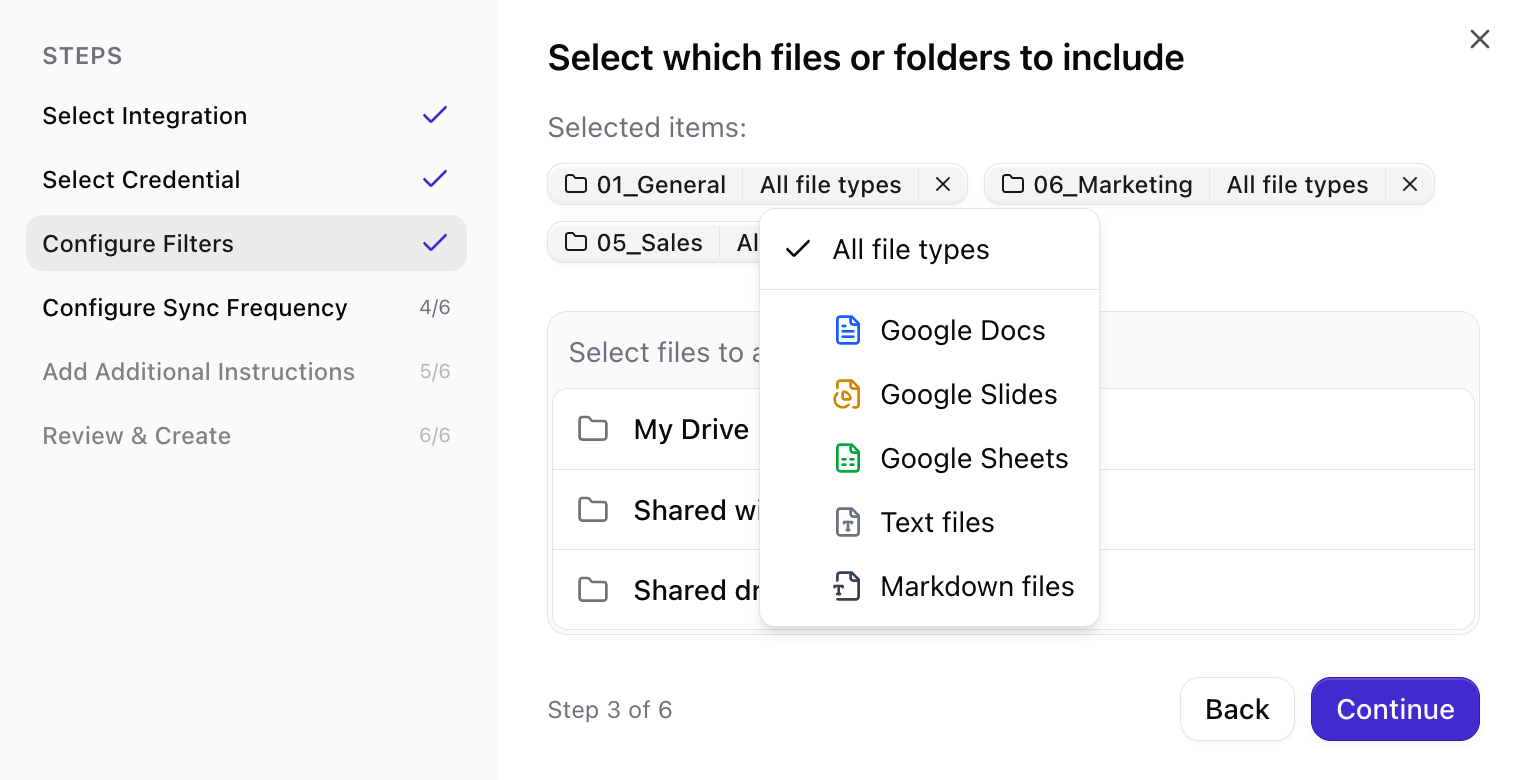
Configure what to sync (filters)
Select the folders and files you want Qontext to ingest into your context repository. You can add folders or individual files.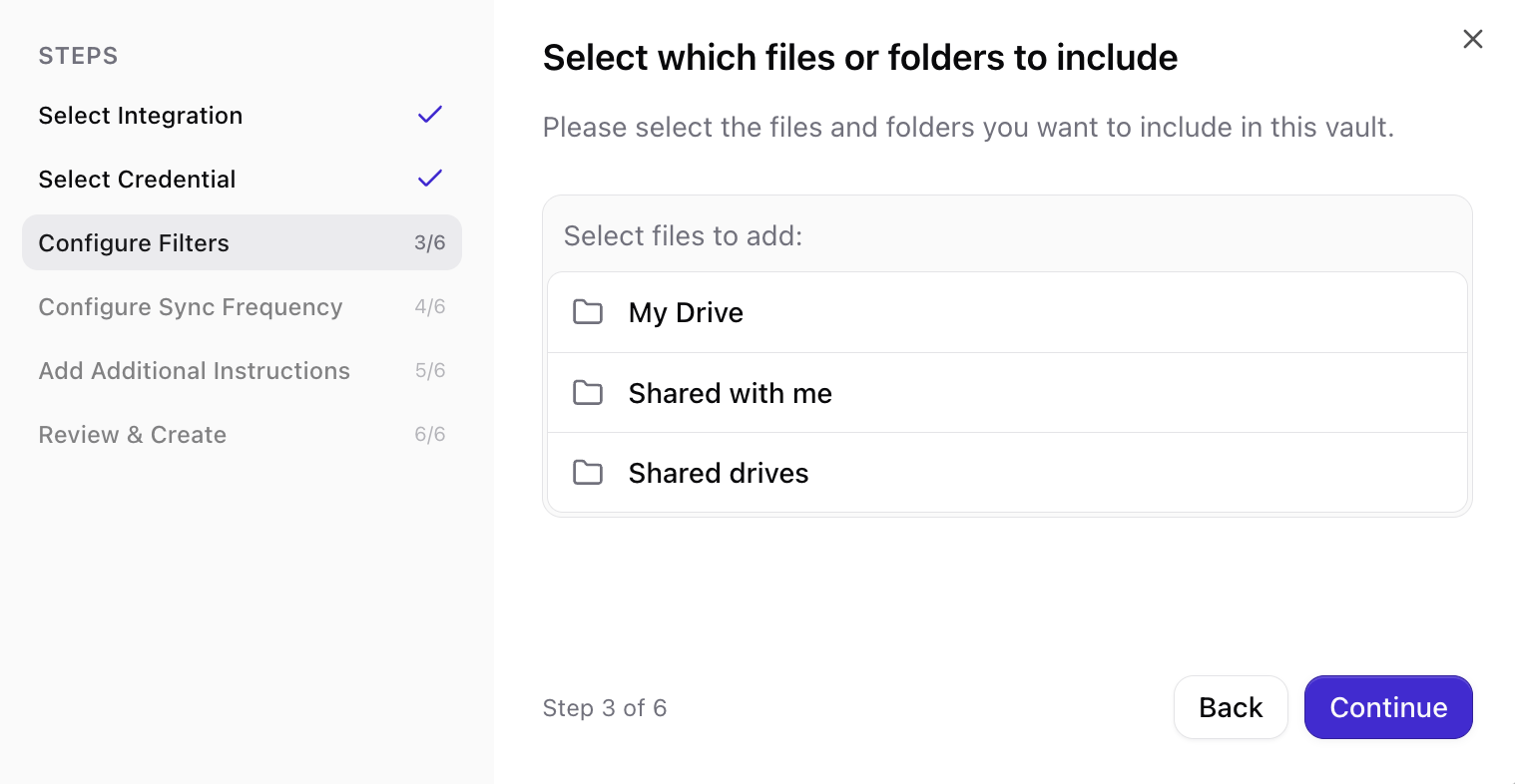
5
Set sync frequency
Choose how often Qontext should refresh data from Google Drive (e.g. daily, weekly, monthly). More frequent syncs keep the context repository up to date but use more resources.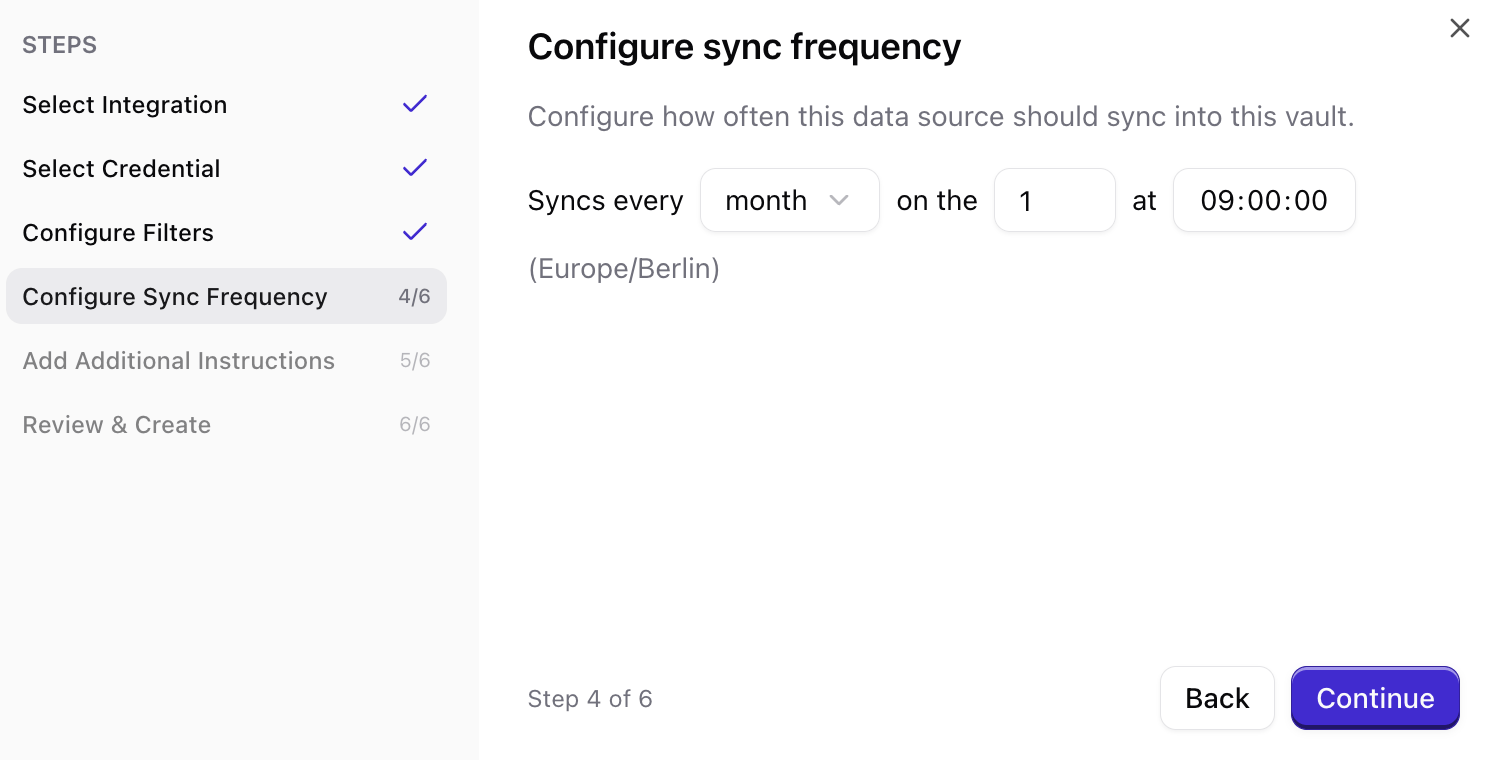
6
Review and create connection
Review your choices (account, filters, frequency), then confirm to create the connection. Qontext will start the initial sync shortly after.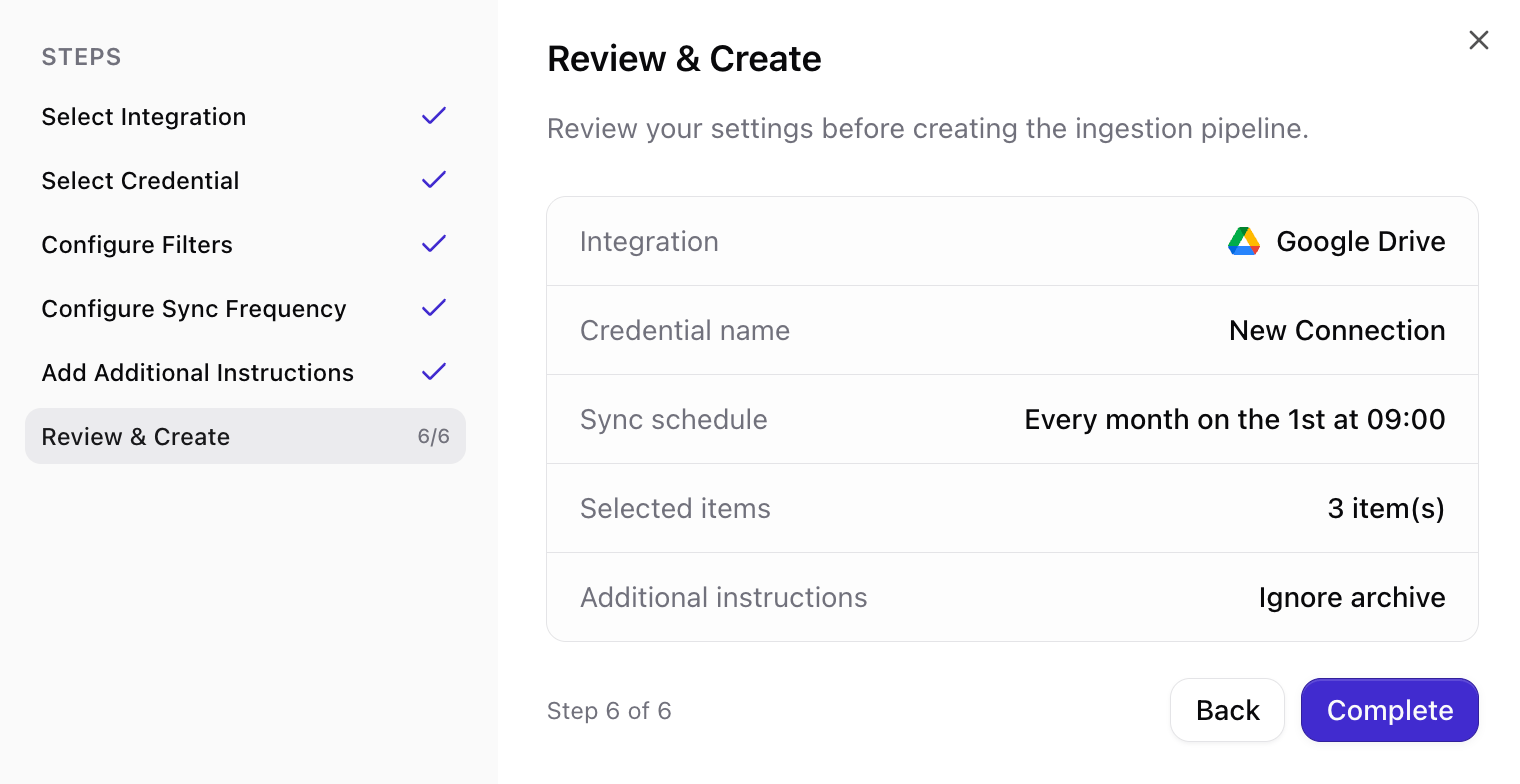
Use your own OAuth client
By default, Qontext connects to Google Drive through its own Google OAuth client. If your organization needs the connection to go through a Google Cloud project you control, you can use your own OAuth client instead. Your Google Workspace admins then manage the consent screen and can revoke access from your own Google Cloud project.Using your own OAuth client is off by default. To turn it on for your workspace, reach out at support@qontext.ai.
Adding your own OAuth client requires the Owner or Admin role in your Qontext workspace (see Member settings), and access to a Google Cloud project where you can create OAuth clients.
1
Copy the Redirect URI from Qontext
In the Qontext app, open your workspace and go to the Sources tab, then click + Connect data source. Select Google Drive, create a new connection, then expand Advanced and open Custom OAuth client. Copy the Redirect URI shown there. It is 
https://app.qontext.ai/oauth/callback/google_drive. If the form shows a different value, use that one instead. You will add it to your OAuth client in Google Cloud.2
Enable the Google Drive API
In the Google Cloud console, select the project you want to use or create a new one. Go to APIs & Services > Library, search for Google Drive API, and click Enable.
3
Configure the consent screen and add the scope
Go to Google Auth Platform and complete the Branding and Audience settings: the app name, the support email, and the user type. Choose Internal if everyone who connects belongs to your Google Workspace organization, otherwise External.Then open Data access, click Add or remove scopes, select 
https://www.googleapis.com/auth/drive.readonly, click Update, and save your changes. This declares the scope your app can request. If the scope isn’t listed, paste it under Manually add scopes and click Add to table.An External app left in Testing status only works for the test users you list, and Google expires its authorizations after 7 days. Publish the app to In production under Audience for a connection that stays active.
4
Create the OAuth client
In Google Auth Platform, open Clients, click Create client, and choose Web application as the application type. Enter a name, for example 
Qontext.Under Authorized redirect URIs, click Add URI and enter the Redirect URI from Qontext, https://app.qontext.ai/oauth/callback/google_drive. Click Create.Google can take from a few minutes to a few hours to apply changes to an OAuth client.
5
Copy the Client ID and Client secret
Google shows the Client ID and Client secret after you create the client. Copy both.
Treat the Client secret like a password. Qontext stores it encrypted and never shows it again after you save it.
6
Add the client to Qontext
Back in the Custom OAuth client section of the connect form, paste the Client ID and Client secret, then continue. Sign in with the Google account that has access to the files you want to sync. Google then asks that account to approve the requested scope. From here, the setup continues as described in Setting up the connection.
Qontext uses the scope
https://www.googleapis.com/auth/drive.readonly (read-only access to your Drive files). If it isn’t granted, the connection is not created. See Google Drive OAuth scopes.Troubleshooting a custom OAuth client
If the connection fails, Qontext shows a message with the error. Find it in the table below.
If the error persists, contact support@qontext.ai.
Managing permissions
Google Drive OAuth scopes
When connecting, you will be asked to grant scopes that allow Qontext to read and download files. Example scope descriptions you may see:Google Drive permissions
- Use a single person or service account to manage Drive permissions for Qontext. This avoids accidental permission changes that break syncs.
- If you don’t see a file in Qontext’s Drive tree, verify download permissions using the file’s File info -> Details and ensure
Viewers and commenters can see the option to download, print, and copyis enabled.
Sync latency
Qontext preprocesses Drive content before ingesting it into the context repository. The initial synchronization time depends on the volume and type of files. Workspaces with many files may take up to 12 hours to fully index.Subsequent syncs process incremental changes and typically complete much faster than the initial sync.
FAQ
Which Google Drive files are supported?
Which Google Drive files are supported?
Qontext supports native Google Docs, Google Slides, and Google Sheets, along with
docx, pptx, xlsx, pdf, rtf, txt, csv, md, odt, odp, ods, and html files. Files larger than 10MB, in an unsupported format, or without extractable text are skipped.Can I connect multiple Google Drive accounts?
Can I connect multiple Google Drive accounts?
Yes. You can create multiple Google Drive connections at any time in the Sources tab in your Qontext workspace.
How do I manually refresh Google Drive data?
How do I manually refresh Google Drive data?
Manual refresh for Google Drive connections is available via the Sources tab. Navigate to the respective Google Drive connection and open the Syncs tab. In the Sync settings, select Sync latest data to pull recent changes, or Resync all data to rebuild the source from scratch.
What happens if I disconnect Google Drive?
What happens if I disconnect Google Drive?
If you disconnect the Drive connection, no new files will be ingested. Content already ingested from Drive will remain in your context repository. For data removal requests, contact support@qontext.ai.
Can I use my own Google OAuth client?
Can I use my own Google OAuth client?
Yes. If your organization wants the connection to go through a Google Cloud project you control, expand Advanced when you add a new connection and use Custom OAuth client. The setup is described in Use your own OAuth client. Qontext still requests the same read-only Drive scope. This option is off by default. Reach out at support@qontext.ai to turn it on.
Is my Google Drive data secure?
Is my Google Drive data secure?
Yes. All data is encrypted in transit (TLS) and at rest. Qontext only accesses files you explicitly authorize via Google OAuth scopes.
How can I limit what Qontext accesses?
How can I limit what Qontext accesses?
By default, Qontext only ingests files the connected Google account can access. Additionally, you can add filters to every connection as described in the setup flow.